
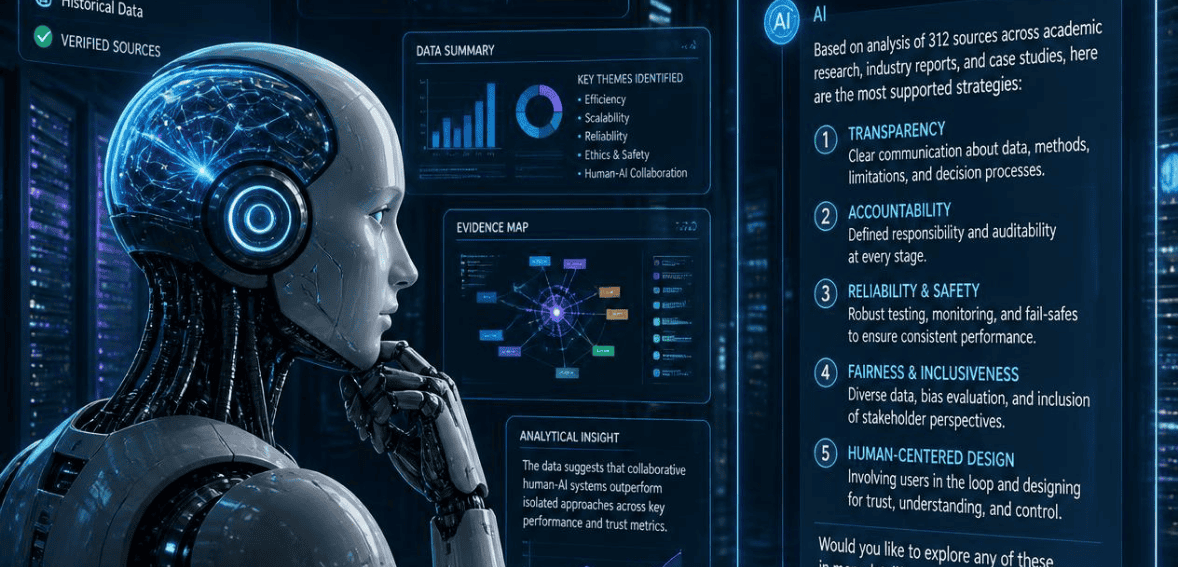
Imagine asking your company’s AI assistant a simple question. “What’s our refund policy for enterprise clients?” It answers in one confident paragraph. It sounds right. But is it? Did it pull from the current policy or a draft from three years ago? Can you click a link and check? If you can’t trace the answer back to a real source, you’re not getting information. You’re getting a guess dressed up in professional language.
Here’s what separates AI that impresses from AI you can actually trust. It comes down to three properties: whether an answer is cited, grounded, and verifiable. Get them right and you have a reliable assistant. Get them wrong and you have built a very persuasive machine for spreading misinformation. Below, we break down what each property means and how modern systems deliver them.
What Are Grounded AI Answers?

A grounded AI answer is a response tied to real, retrievable source material. The model doesn’t invent facts from memory. Instead, it pulls relevant documents first, then writes an answer based only on what it found.
Consider the difference between diligent students and bluffers. Grounding systems help language models communicate from the research instead of bluffing. Language models, like GPT, have a training data cut-off. They can’t know about use cases closer to you, like your pricing, your internal wikis, and product updates. This can lead them to produce responses that appear accurate, but they can be wrong and we refer to these as “hallucinations.”
Grounding addresses this by tying the model to current, retrievable sources. For enterprises, that is the difference between a demo and a system people can actually rely on.
Cited, Grounded, and Verifiable: What Each Word Really Means
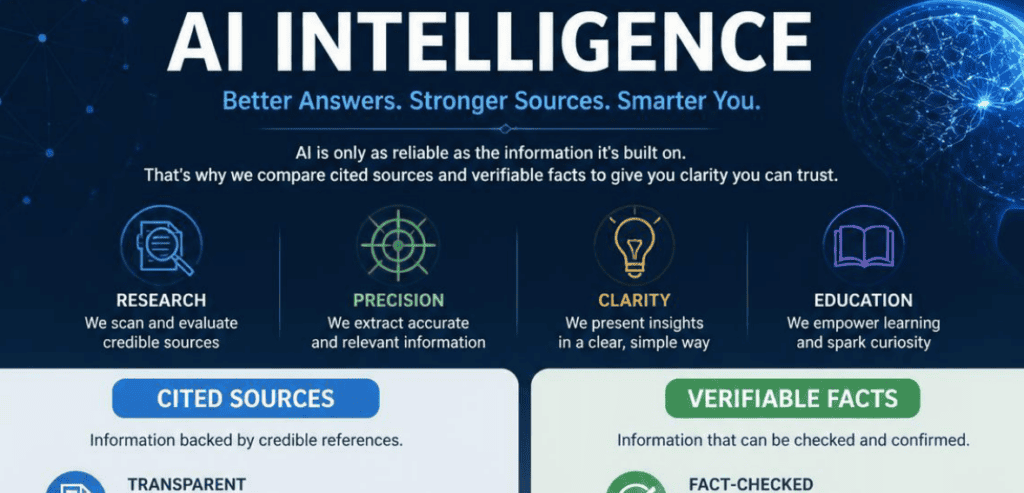
These three words get used together so often that people assume they mean the same thing. They don’t. Each solves a different problem, and you need all three working together.
Grounded
Grounded refers to answers based on retrieved evidence. The AI searches a knowledge base, locates relevant documents, and composes a response limited to those documents. Without grounding, everything else fails. You cannot cite a document that was not referred to, and it is impossible to substantiate a claim that was created out of nothing. Grounding is the base.
Cited
Cited means the answer shows its work. It points to the specific document, page, or passage that supports each claim. A good citation includes enough detail that a reader can find the exact source. This is what transforms a black-box response into something transparent. When your AI says “enterprise refunds are processed within 30 days” and links to the current policy document with an effective date, you can see where that number came from.
Verifiable
Verifiable is the payoff. A claim is considered verifiable if someone can check the claim against the source and validate it. Citations are what make verification possible; without them there is nothing to check against. This is incredibly important in fields where an incorrect answer would have dire consequences, such as healthcare, law, and finance. A verifiable system allows a junior employee to check an answer prior to taking action, as opposed to trusting it.
How Retrieval-Augmented Generation Powers Grounded AI Answers
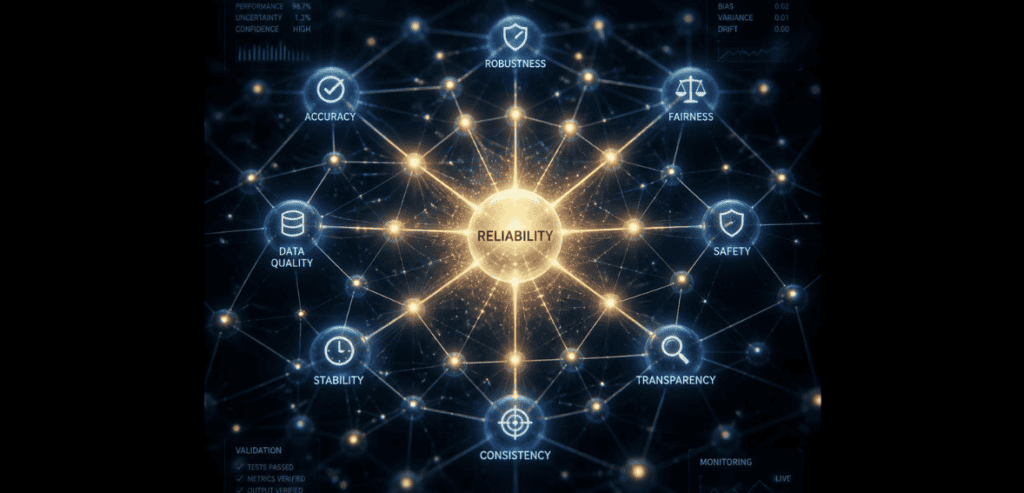
The most widely used technique for producing grounded AI answers is Retrieval-Augmented Generation, or RAG. It was introduced in a landmark 2020 paper by Patrick Lewis and colleagues, and it has become the backbone of enterprise AI search.
It is simple to use. Users input questions. The system scans its knowledge base for relevant documents. Those documents and the question are sent to the language model. The model provides the answer based on the documents. As answers are based on documents, the system is able to provide citations for each answer. These citations explain what documents each answer is based on. For the technical details of the process, refer to the original RAG research paper on arXiv.
RAG is useful because it simplifies the process for the model. Rather than generating the answer based on what the model knows, the model is now able to generate the answer based on the documents. This process eliminates a lot of guessing the model is forced to do, and as a result, greatly reduces hallucinations. Answers are based on the knowledge base, so answers won’t become outdated as quickly.
The system reduces hallucinations, but it is not a cure. The answer depends entirely on what gets retrieved. If the system pulls documents that do not actually address the question, the model may still produce a confident answer built on the wrong evidence. That retrieval failure, not the model’s writing, is where these systems most often break down.
Why Citations Alone Don’t Make an Answer Trustworthy
Here’s an uncomfortable truth. An answer can look perfectly grounded and still be wrong.
Some AI outputs include quotes, hyperlinks, and official-sounding document titles that appear to back a claim but do not actually support it. Researchers call this a citation-shaped hallucination: a plausible-looking source is attached to a claim it never made. It is more dangerous than a plain hallucination, because an uncited error invites skepticism while a cited error manufactures trust.
This is why practitioners separate two ideas: correctness and faithfulness. Correctness is whether the claim itself is factually true. Faithfulness is whether the claim actually reflects what the cited source says. The two can come apart in both directions. An answer can be correct by luck while being unfaithful to the source it cites, and an answer can faithfully report a source that is itself outdated or wrong.
When employing AI, the principle is quite clear. Do not assume a cited source is correct just because the claim is supported by a citation. In order to guard against citation-shaped hallucinations that would otherwise train users to unreasonably trust the wrong answer, be sure to evaluate whether the cited passage supports the claim.
How to Measure Grounding and Faithfulness
You can’t improve what you don’t measure. Serious AI systems score how well an answer sticks to its sources.
A grounding or support score is a popular method for measurement. This score (usually between 0 and 1) is a quantifiable measure for how much an answer is substantiated by the evidence. Some cloud platforms provide built-in support for this score and indicate which specific pieces of evidence support each claim. Google’s documentation on grounding in the context of RAG is a good reference for the practical use of this score.
Faithfulness metrics extend this idea by measuring the answer on a sentence-by-sentence basis, and comparing it against the evidence in the cited text. Sentences with no supporting evidence are flagged. Measuring the ratio of unsupported sentences answers the question of how much a particular model has drifted from its source. This is a measure that allows teams to catch problems automatically and at scale, as opposed to slow, manual reviews.
Real-World Tools That Deliver Grounded AI Answers
Several platforms have built their reputations on producing verifiable, source-backed responses. Here’s how a few approach the problem.
Google Cloud
Google’s Vertex AI Search provides RAG infrastructure for companies that want to build AI agents on their own internal data. It comes with enterprise-level security and features for compliance with regulations and certifications such as HIPAA and SOC. Its grounding check returns a support score and cites the source of the claim, enabling teams to validate that the answer is supported by reference material rather than model conjecture.
Glean
Glean focuses on permission-aware internal knowledge search. Its strength is aligning answers with source access, meaning an employee only sees answers drawn from documents they are actually allowed to view. That makes it a strong fit for IT, HR, and operations teams that need fast, employee-facing grounded AI answers while respecting internal confidentiality walls.
AI21 Labs
AI21 believes that enterprise AI requires grounding to be trustworthy and RAG (retrieval augmented generation) really focuses on that. Key to RAG is source attribution and auditability. This means users can follow the AI’s reasoning back to the document (or source) on which it is based. AI21 also notes that RAG is not a finished product but a pipeline of components working over varied data. Some models are markedly better than others at staying faithful to retrieved content, so model choice still matters even inside a well-built RAG system.
Building Blocks of a Verifiable Enterprise AI Search
The organizations getting this right share a common insight. The magic isn’t in the model. It’s in everything built around it.
Start with retrieval quality, because the model can only work with what it is handed. Next comes content quality: messy, incomplete, duplicated, or stale documents produce messy answers no matter how good the model is. Permissions matter too, since a proper enterprise system returns different answers to different users based on what each is allowed to see, and surfaces the effective date alongside the answer. Finally, auditability ties each answer back to a specific source, removing the uncertainty that comes with claims you cannot trace.
These elements should be viewed as the product, rather than just the model. That is the key difference that will transform a dazzling demonstration into a system that your team will actually trust on the following Monday.
Conclusion
Cited, grounded, and verifiable aren’t buzzwords. They’re a chain of trust. Grounding anchors an answer to real evidence. Citations expose that evidence. Verification lets a human confirm the whole thing holds up. Break any link, and the answer becomes a confident guess.
As AI moves deeper into how we work, the demand isn’t just for answers. It’s for answers you can check. The best systems don’t ask you to trust them. They hand you the receipts and invite you to look. When you’re evaluating any AI tool, stop asking “does it sound smart?” and start asking “can I trace this back to the source?” That single question is the fastest way to tell a reliable system from a persuasive one.
Frequently Asked Questions
What is the difference between a grounded and an ungrounded AI answer?
An ungrounded answer comes from the model’s training data and internal memory, which can be outdated or invented. A grounded answer is built from real documents the system retrieves at the moment you ask, so it reflects current, verifiable sources. Grounded AI answers are far less likely to hallucinate.
Can grounded AI answers still be wrong?
Yes. Grounding and RAG reduce errors but don’t eliminate them. Systems can retrieve the wrong documents, or they can attach citations that don’t truly support a claim, known as citation-shaped hallucinations. That’s why verification and grounding scores still matter.
What does “verifiable” actually mean for an AI answer?
Verifiable means a person can independently trace a claim back to its cited source and confirm it’s accurate. It depends on clear citations that point to the specific document, passage, or effective date, so a reader can check the answer rather than trusting it blindly.
Do I need RAG to get citations and grounding?
Retrieval-Augmented Generation is the most common and practical way to produce cited, grounded AI answers, but it isn’t the only method. Grounding can also come from live web search or direct database connections. RAG remains the standard for enterprise search because it balances accuracy, freshness, and traceability.