
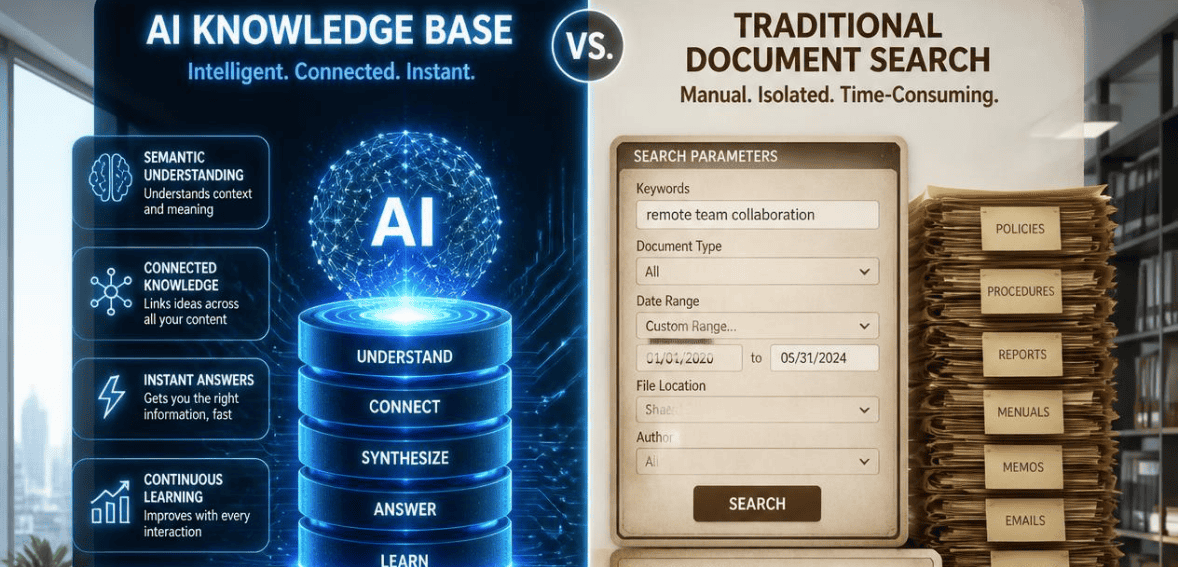
Picture this. An employee needs one answer buried inside a 40-page PDF. She types three keywords into the company search bar. She gets 200 results. None of them answer her question directly. She gives up and messages a coworker instead. This scene plays out inside offices across the US every single day. It is the quiet tax that traditional document search charges on every knowledge worker.
Now consider a different context. That same employee types a simple question into an AI assistant. Within seconds, she retrieves a direct answer along with a citation directing her to the exact paragraph. There’s no scrolling through a million search results. She doesn’t have to reach out to a coworker to ask for help. It’s the real answer-based difference between a traditional document search and an AI knowledge base. This is the way it’s going to change how American companies work with information in 2026.
This article explains both systems and AI Knowledge Base vs Document Search in simple terms. You’ll see how both systems work, how they fail, and the best way to determine if either system is right for your organization. We’ll be covering the tech behind this disruption, retrieval-augmented generation, and semantic search, and we’ll put this in the context of cost, security, and ease of integration.
What Is Traditional Document Search
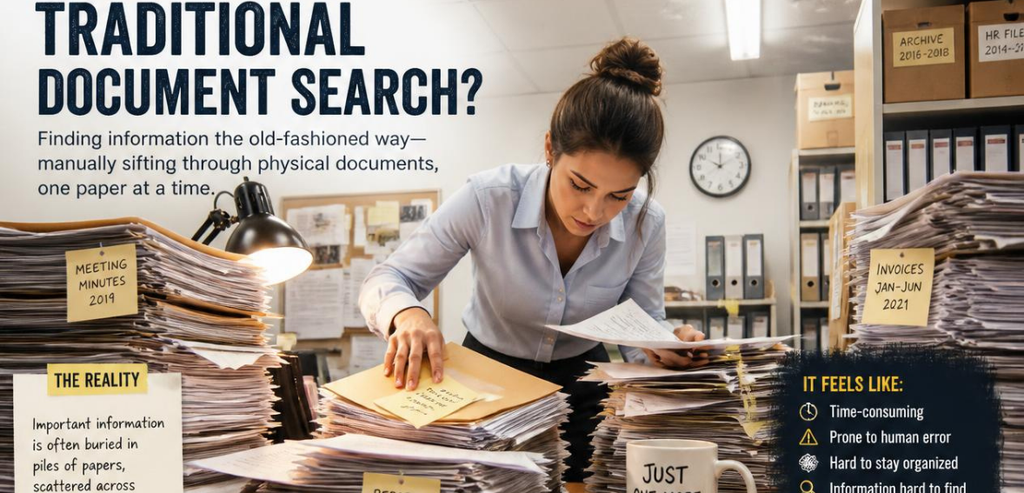
Traditional document search is the model most companies have used for decades. Think of tools like SharePoint search, a company intranet, or a basic file explorer. These systems index documents and match a user’s typed keywords against the text inside those files. If the words match, the document shows up in the results list.
The main issue with this model is the onus it places on the human. A user must understand the answer to the query well enough to know what to ask, how to guess what the original author of the content would have said, and synthesize the answer after consulting a number of related documents. Older systems are hurt by the same issues. Searching for “vacation policy” may return nothing and fail to locate a document named “time off guidelines” even if the answer is present.
Older knowledge systems often rely on rigid cataloging and folder systems done by people. Manual upkeep is required to preserve search quality. The answer systems decay and lose utility for the people that they were constructed for, and simply become more digital clutter.
Microsoft SharePoint
Microsoft SharePoint remains one of the most common examples of traditional enterprise search in the US market. It organizes files into sites, libraries, and folders, and its built-in search relies heavily on exact keyword matches and metadata tags. SharePoint works well for storing and permissioning files, but employees often report that finding a specific answer inside a large SharePoint environment still takes real effort and several searches.
What Is an AI Knowledge Base
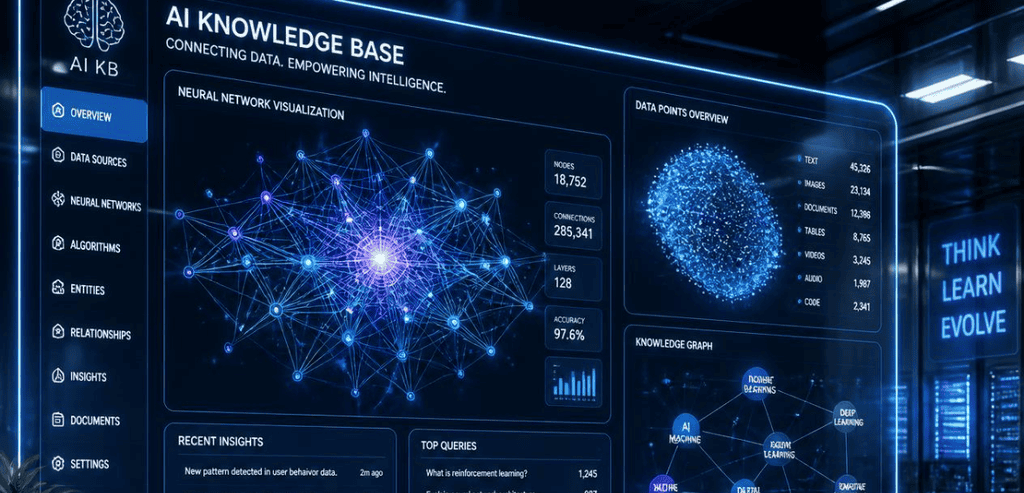
An AI knowledge base provides an advanced method of answering questions posed by end-users. Traditionally, services offered by knowledge bases would provide a set of documents that answer a query. An AI knowledge base uses a method that combines retrieval and generation (RAG), which provides a more conversational way of answering questions. RAG learns and documents the contents of a company’s files. When presented with a question, RAG uses company documents and files to provide an answer instead of using prior general knowledge.
The technology that RAG is built upon is called a vector search. A vector search does not rely on matching keywords. Instead, a vector search is able to convert text to numbers and encode the semantic meaning of the text. This allows an AI knowledge base to match a question about “employee time off” with a document that contains the “vacation policy.”
An AI knowledge base is able to harness the context of multiple documents, provide citations, and indicate when it does not have enough information to provide an answer. It is important that systems are able to communicate, “I do not know,” to preserve trust and lower the chance of failing to answer correctly.
Glean
Glean is a widely used example of an AI knowledge base built for enterprise search across many connected workplace tools. It links to platforms such as Slack, Google Drive, and Jira, then applies AI to surface answers drawn from all of them in one place. Companies choosing Glean typically want broad coverage across scattered SaaS tools rather than a single, tightly controlled repository.
CustomGPT.ai
CustomGPT.ai is a variant of AI knowledge bases that builds its own methodology around RAG architecture and source citation frameworks for regulated markets. It ingests documents in multiple formats. It innovatively organizes its knowledge and is capable of updating it automatically when the source documents are changed. It also utilizes source citations in the generated answers. Compliance teams are able to inspect the source of information and the answers for each citation. It is attractive for the healthcare, financial services, and government contracting markets since unverifiable answers pose a risk.
AI Knowledge Base vs Document Search: The Core Differences
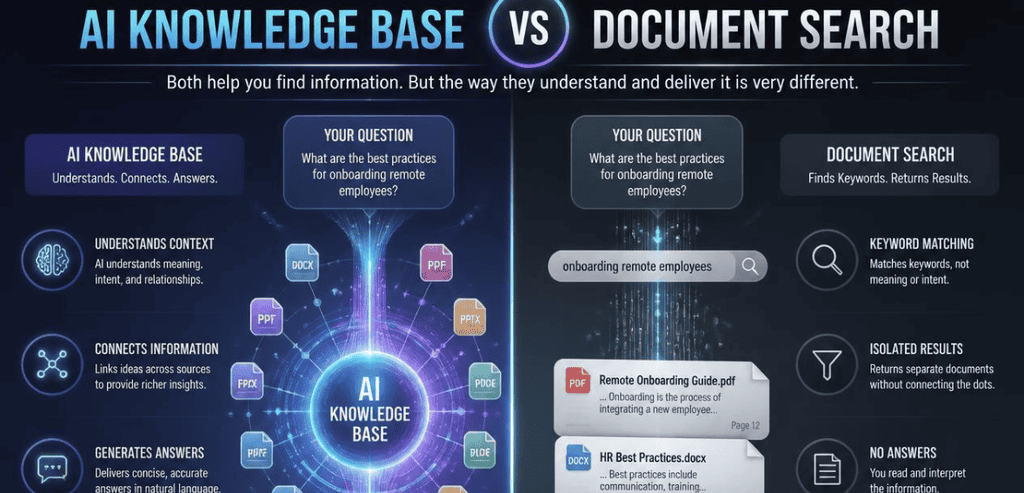
AI knowledge base vs document search is best explained through understanding where the burden of explanation lies. With traditional document search, the burden is on the user. The user has to go through the entire ranked list, open multiple documents themselves, and combine the answer. The burden with an AI knowledge base is on the system. The AI processes the documents and the answer is built for the user.
Search systems of the past required constant manual labor. Someone had to go through and tag content, create an order to the folders and documents, and revise the categories with the changes in the business. An AI knowledge base doesn’t operate the same way. While it still needs to have quality content built, the AI can comprehend the content and answer the user’s questions even if the content is not tagged, categorized, or organized.
Each model has its own challenges with precision. Traditional systems are easier to work with, as they fail in a rather obvious manner to the user. The user is simply unable to locate a given document. Failing in an obvious manner does not happen with AI systems. If the core of the system is not properly grounded, it can provide incorrect, yet confident and well-structured responses. This is the exact reason why grounding and citations are extremely important in the evaluation of an AI knowledge-based system. A system that displays its citations can easily close this failure gap in a meaningful way.
Speed is another major differentiator. Currently, people spend anywhere from hours to days to weeks manually sifting through files to find the right document. Knowledge workers actually lose days out of the week to this process. McKinsey found that a well-organized and searchable company knowledge repository can reduce the time employees spend looking for information by a third. This is based on the internal social technology adoption data found in McKinsey’s article on productivity. An AI knowledge base increases this time savings exponentially because it skips the entire document review step and delivers the answer directly.
Why This Shift Is Happening Now in 2026
A few forces are coming together. Company information is now spread across many different systems (chat tools, cloud storage, ticketing and tracking systems, internal wikis). There is no universal, well-functioning keyword search across all of them. At the same time, embedding models and vector databases have progressed and can now be used reliably at an enterprise level, making semantic search a viable option. Companies are working to lessen the cost of employees asking the same questions, duplicating tickets, and making poor decisions based on out-of-date information.
For many companies operating in a regulated environment, the challenge is compounded because they often require responses that are both quick and verifiable. An AI knowledge base that uses retrieval-augmented generation (RAG) with mandatory citations will provide compliance and audit teams the ability to validate the answer with the source, something a standard chatbot cannot provide.
This is not to say that traditional repositories of documents will cease to exist. Companies will continue to require systems of structured document storage and control. Most companies will operate with the same document storage systems used by their employees and have AI integrated into their systems. It is not about the replacement of document storage. The goal is to eliminate the frustrating, time-consuming search for a singular answer.
Choosing the Right Approach for Your Organization
The right option comes down to your team’s specific pain points. For example, if you have issues with files scattered across too many tools without a central location to even search, then broad workplace search tools that integrate multiple sources would be the most appropriate. If your issues are around trust and the need to show provenance of an answer, then typically the safest option, especially in highly regulated industries, would be to use a RAG-native tool that cites sources. If your organization is already using one vendor’s tools extensively, the AI-native tool of that vendor would typically be the most appropriate option (and would require the least training) to integrate with that toolset.
No matter what option you choose, a few basic principles hold true. Quality source content that is current is a requirement, since no model can answer questions based on outdated content. The AI component must be integrated with the security and permission infrastructure, so users see only answers based on content they have permission to access. Each implementation should be measured against objective metrics to determine success, including a decrease in the number of support requests and a decrease in the amount of time employees spend searching for answers.
Conclusion
The crux of the AI knowledge base vs. document search debate is where time and energy is allocated. With traditional document search systems, the burden of reading, filtering, and synthesizing is placed on the user. The AI knowledge base takes care of this burden by delivering a synthesized answer directly. The other systems still require the user to do the reading and filtering themselves. Neither system lessens the need for good, structured information, nor does either system reduce the risk of poor implementation.
However, for the organizations that are overwhelmed by unorganized, disjointed information and repetitive queries to which they have to manually respond, the AI knowledge system is the most efficient, most human-centric, and most understandable system to provide quicker access to information and answers. Based on everything currently available, the best approach for most businesses in the United States in 2026 will be to implement AI-based retrieval systems and stack them on top of trusted document systems, instead of choosing one of the two systems and completely ignoring the other.
Frequently Asked Questions
Is an AI knowledge base more accurate than traditional document search?
It depends on how the AI system is built. A well-grounded AI knowledge base that cites its sources and pulls only from verified company documents tends to produce more useful, direct answers than a keyword search tool. However, if an AI system is not properly grounded in real source material, it can generate a confident answer that is factually wrong, so source citation and verification features matter a great deal when judging accuracy.
Do we need to get rid of our existing SharePoint or file storage to use an AI knowledge base?
No. Most AI knowledge base tools connect to existing storage systems like SharePoint, Google Drive, or Confluence rather than replacing them. The AI layer reads and indexes content from those existing sources, so your document infrastructure and permission structure typically stay in place.
How long does it take to set up an AI knowledge base for a mid-sized company?
Timelines vary by vendor and by how much existing content needs cleanup before ingestion, but many modern platforms are designed for deployment in a matter of weeks rather than months, especially no-code options that do not require dedicated engineering resources.
Can small businesses benefit from an AI knowledge base, or is this only useful for large enterprises?
Small businesses can benefit as well, particularly if their team spends noticeable time answering repetitive internal questions or if customer support tickets often repeat the same basic issues. Many AI knowledge base platforms now offer pricing tiers built specifically for smaller teams, making the technology accessible well beyond large enterprises.